



Most ecommerce landing pages fail because the page does not guide that traffic toward a clear decision. In practice, many stores invest heavily in ads, SEO, and influencers, but the landing experience becomes fragmented, unclear, or overloaded with unnecessary information.
A high-impact ecommerce landing page works differently because it is designed as a focused conversion environment where every section exists to support one outcome: helping the visitor understand the offer quickly and take action without hesitation.
This requires structure, clarity, and a deliberate approach to how content, design, and user flow interact.
For ecommerce teams working with paid traffic or scaling organically, understanding landing page structure is a practical advantage. It directly affects conversion rates, acquisition efficiency, and overall revenue per visitor.
What “High-Impact” Actually Means
It’s Not About Looking Good
A visually polished landing page can still underperform if the structure does not support decision making. Many brands confuse aesthetic quality with conversion quality.
Clean typography and modern layouts are helpful, but they do not replace the need for clarity in messaging and flow.
What matters more is whether the page answers essential user questions in the correct order. What is this product, why should I care, and why should I trust it. If those answers are not immediate and easy to understand, design becomes secondary.
It’s About Reducing Decision Friction
Every extra moment of confusion increases the chance of abandonment. Decision friction appears when users need to interpret unclear messages, search for missing information, or mentally connect disconnected sections.
High-performing ecommerce landing pages reduce this friction by structuring information so that each scroll builds on the previous one. The user does not need to think about where to look next. The page guides them naturally from awareness to consideration to action.
This is achieved through practical decisions in layout, messaging, and hierarchy. Clear section sequencing reduces cognitive overload because the user is not forced to interpret multiple pieces of information at the same time.
Strong visual hierarchy ensures that attention is directed first to the value proposition, then to supporting proof, and only then to secondary details. Consistent messaging across sections prevents confusion that typically leads to hesitation or page abandonment.
When these elements work together, the landing page reduces the mental effort required to understand the offer and increases the likelihood of a decision being made within the same session.
This is where strategic ecommerce landing page design becomes essential, because structure and clarity directly influence conversion outcomes.
Every Element Must Support the Sale
A landing page is a decision environment, which means every element must actively reduce uncertainty and support the buying decision. Headlines, visuals, product explanations, spacing, and section order all influence how quickly the visitor understands the offer and how easily they move toward action.
When these elements work together, the page becomes easier to interpret because each component reinforces the next instead of competing for attention.
When irrelevant or redundant elements are introduced, they create cognitive noise. This happens when sections do not add clarity, repeat information without purpose, or introduce secondary messages that distract from the main offer.
The result is higher mental effort, slower comprehension, and increased friction in the decision process. Removing this noise or reorganizing it into a clearer hierarchy improves focus, which directly increases the likelihood of conversion.
Start With One Clear Goal
One Page, One Objective
The most effective landing pages are built around a single objective. That objective may be a product purchase, a subscription, or a lead submission, but it should never compete with secondary actions.
When multiple goals are introduced, attention splits. A user unsure whether to explore products, read blogs, or sign up tends to delay action or leave entirely. Simplicity in objective leads to clarity in behavior.
Aligning Traffic With Intent
A landing page must match the expectation created by the source of traffic. If a user arrives from a paid ad promising a specific solution, the landing page must immediately reflect that promise.
This alignment is often underestimated. Even strong design and copy cannot fully recover from a mismatch between ad message and landing experience.
Think of the landing page as a continuation of the conversation that started before the click. If that continuity is broken, conversion drops regardless of design quality.
The Structure of a High-Converting Landing Page
Before looking at individual sections, a landing page should be understood as a sequence of progressive clarity, where each part builds understanding, reduces uncertainty, and supports the decision.
When this structure is not intentional, the page becomes disconnected and harder to evaluate.
Above the Fold: First Impression That Decides Everything
The first screen determines whether the user stays or leaves. It must communicate value with minimal effort from the visitor.
Key components include a clear headline that states the offer, a supporting subheadline that adds context, a relevant visual that reinforces the product or outcome, and a visible call to action that signals what to do next.
If a visitor cannot understand what is being offered within seconds, the remaining content often goes unread.
Middle Section: Building Trust and Clarity
Once attention is captured, the middle section reinforces understanding and reduces uncertainty. This is where benefits should be presented in practical terms, explaining how the product changes the user experience.
Supporting elements such as customer reviews, user generated content, and simple product explanations help build credibility and reduce hesitation in your ecommerce store.
For ecommerce brands, this is also where clarity around usage, materials, or differentiation should appear without overwhelming technical detail.
If the user needs to scroll multiple times to understand the product value, the structure needs refinement.
Bottom Section: Removing Final Objections
At this stage, users are evaluating risk. The role of the final section is to remove hesitation.
Guarantees, frequently asked questions, and subtle urgency cues help close the gap between consideration and purchase. This is also where reassurance elements should be consolidated, so the user does not need to search for final answers elsewhere on the page.
Visual Hierarchy That Guides the User

Where the Eye Goes First
Visual hierarchy determines what the user notices first, second, and third. Size, contrast, and spacing guide attention more than decorative design choices.
If everything on the page competes for attention, nothing stands out. Hierarchy creates direction, which improves comprehension speed.
Using White Space to Create Focus
White space is not empty space. It is a structural tool that improves readability and focus.
When elements are spaced effectively, users can process information in smaller cognitive chunks. This reduces overwhelm and makes the page feel more intentional and easier to navigate.
Designing for Scanning, Not Reading
Most users do not read landing pages line by line. They scan for signals that confirm relevance, especially in environments where how you improve landing page design directly influences conversion.
This means key information must be visually accessible at multiple points on the page. Headlines, short paragraphs, and clearly separated sections make the content easier to process, improving scanability and helping users understand the offer faster, which increases the likelihood of engagement and conversion.
The Role of Copy in Design
Copy is one of the main forces that shapes how a landing page is understood, not just what it says. It guides attention, reduces ambiguity, and gives structure to the visual experience, making it easier for the user to interpret what they are seeing and why it matters.
Without clear copy, even well-designed pages tend to lose direction.
Headlines That Answer “Why Should I Care?”
A headline should immediately establish relevance. If it requires interpretation, it is too complex.
The most effective headlines communicate outcome or value in direct language. They remove ambiguity rather than add creative expression.
Benefits Over Features
Features describe what a product is. Benefits describe what the user gains. In conversion environments, benefits carry more weight because they connect directly to decision making.
Instead of focusing on technical specifications alone, effective landing pages translate them into outcomes that matter to the customer.
Reducing Cognitive Load With Simple Language
Complex language slows down comprehension. In ecommerce, slower comprehension often leads to lost conversions.
Simple language does not reduce sophistication. It increases accessibility. The goal is to make understanding effortless so that attention can shift toward evaluation rather than interpretation.
Trust Elements That Make or Break Conversion
Trust plays a critical role in conversion because it directly affects how comfortable a user feels about taking action on a landing page.
Even when the offer is clear and relevant, hesitation often comes from a lack of validation that the product or brand is credible and reliable.
Social Proof Placement
Reviews, testimonials, and user generated content should not be isolated in a single section. Their placement throughout the page reinforces credibility at multiple decision points.
When users see validation repeatedly, hesitation decreases.
Guarantees and Risk Reversal
Buying online always involves perceived risk. Clear guarantees reduce this friction by shifting perceived downside away from the customer.
This can include satisfaction guarantees, return policies, or quality assurances that are easy to understand without legal complexity.
Brand Consistency Across the Page
Trust is also visual. Inconsistent design, tone, or messaging creates doubt even if the product is strong.
Consistency in typography, color usage, imagery style, and tone of voice signals reliability and professionalism.
Mobile First Design Isn’t Optional
Mobile optimization is a core requirement for landing page performance, since most users now interact through mobile devices.
When the experience is not designed for small screens, navigation becomes harder and comprehension slows down, which directly impacts conversion.
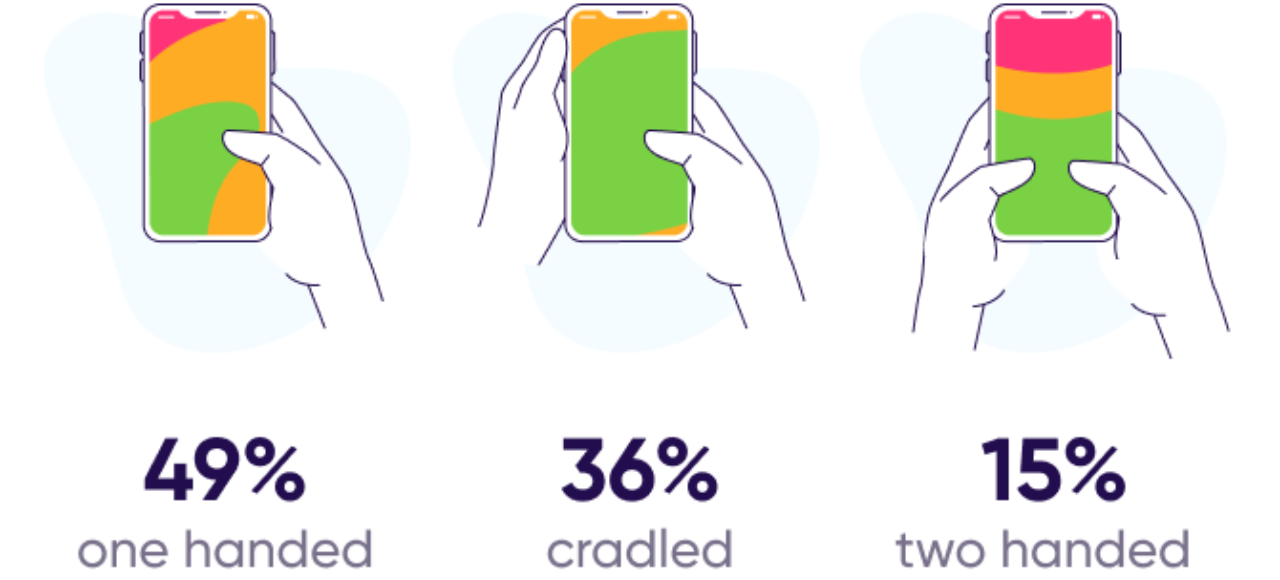
Thumb Friendly Layout
Thumb-friendly layout refers to how easily a user can interact with a page using one hand on a mobile device, where most actions are performed with the thumb.
This affects how buttons are sized, how far key elements are placed from each other, and where interactive components are positioned on the screen.
When important actions like “Add to Cart” or “Buy Now” are too small, too close together, or placed in hard-to-reach areas, users are more likely to make mistakes or avoid interacting altogether.
By designing with thumb reach in mind, the interface becomes more natural to use, reducing friction during navigation and making key actions faster and more accurate to execute.
Simplified Content for Small Screens
Mobile screens require prioritization. Content must be structured so that only the most important information appears first, with supporting details accessible but not dominant.
Speed and Load Experience
Page speed and load experience directly influence how users interact with a landing page from the very first moment. If a page takes too long to load, users often leave before any content is even displayed, which means the offer is never evaluated.
This affects both conversion rates and SEO performance because slower pages reduce engagement signals and increase bounce rates.
Optimizing performance through lighter assets, efficient code, and faster server response ensures that the content is actually seen and can perform its role in guiding the user toward a decision.
Common Landing Page Mistakes That Kill Impact
Too Much Information
Overloading a page with details creates confusion. When everything is emphasized equally, users struggle to identify what matters most.
Weak or Hidden CTA
If users cannot easily identify the next step, they do not take it. Calls to action should be visually and contextually clear throughout the page.
Mismatch Between Ad and Page
When messaging differs from the original traffic source, users feel disoriented. This disconnect is one of the most common conversion killers.
Overdesigned Pages
Excessive visual complexity often reduces clarity. A landing page should prioritize function over decoration.
Designing as an Iterative Process
Test Before You Scale
Landing pages should be treated as evolving systems. Initial versions are starting points, not final assets.
Small Changes, Big Impact
Adjustments to headlines, button placement, or section order can significantly change conversion outcomes. Continuous refinement is essential.
Measure What Actually Matters
Traffic and engagement metrics are useful, but conversion rate and revenue per visitor are the primary indicators of landing page effectiveness.
For teams optimizing performance, aligning with structured frameworks like CRO and Product Page Optimization can help extend these improvements across the entire funnel, including Checkout experience.
Conclusion
A high-impact ecommerce landing page is built on clarity, structure, and intentional flow. It is not defined by how visually impressive it looks, but by how efficiently it guides a visitor toward a decision.
The key question remains simple. If a new visitor lands on your page today, is it immediately clear what is being sold, why it matters, and what action they should take next.
When the answer is yes, the page becomes a predictable and scalable acquisition asset rather than a passive destination.
If your landing page isn’t clearly guiding visitors, it’s likely leaving revenue on the table.
At Vasta, we help turn unclear pages into structured experiences that naturally lead users to take action, with every section working toward a clear goal.
Book a call and start turning your traffic into consistent, scalable growth.