


There is a question every e-commerce founder should ask themselves at least once a quarter: "If a new customer reads my testimonials today, do they see proof, or just empty praise?"
Most stores have reviews. Most of those reviews are forgettable.
"Great product, fast shipping. Would buy again." Nice to have, but it does almost nothing for conversion. The person reading it does not see themselves in that sentence.
They do not feel the before. They cannot imagine the after.
Real and effective testimonials work differently. They are not just validation. They are a shortcut through doubt, a mirror that helps a hesitant buyer say: "That is me. That could work for me too."
This article breaks down what makes customer testimonials in e-commerce actually move the needle, with real-life effective testimonials examples and a concrete framework you can apply to your store today.
Why Testimonials Still Influence Buying Decisions
People Trust People More Than Brands
It sounds obvious, but the data keeps proving it. According to BrightLocal's 2023 Consumer Review Survey, 95% of consumers read reviews before making a purchase, and 49% trust them as much as a personal recommendation from a friend.
That is nearly half your traffic arriving already primed to be influenced by what other customers said.
The math is simple: your brand voice tells people what you want them to believe. Customer testimonials in e-commerce tell people what others actually experienced. The second one wins, almost every time.
The Risk Factor in E-commerce
Online shopping carries an invisible emotional tax: risk. According to Baymard Institute research on cart abandonment, a lack of trust is a leading reason for lost sales.
Buyers cannot touch the product, smell it, try it on, or ask a question in real time. Every click toward "Add to Cart" is a small act of faith, and faith erodes fast in the face of uncertainty.
This is exactly why social proof is a cornerstone of any effective e-commerce CRO strategy. When a real customer describes a real outcome, such as the energy she did not have before, sleep she could not get, a problem that finally got solved, the abstract becomes tangible.
The risk feels smaller. The decision feels safer.
Testimonials as Decision Shortcuts
Your customer's brain is constantly looking for shortcuts. Research in behavioral psychology shows that in a situation with two similar products, consumers are significantly more likely to choose the one with more reviews, even if the rating is slightly lower.
Volume signals trustworthiness. Specificity signals authenticity. Both together form a conversion asset that very few brands use to its full potential.
Testimonials sit at the intersection of social proof and storytelling. Used well, they do not just support your product page. They do the heavy lifting of persuasion so your copy does not have to.
What Makes a Testimonial Actually Effective

Understanding the difference between a testimonial that converts and one that gets ignored is the foundation of any serious testimonial best practices framework. It comes down to three things.
Specificity Over Generic Praise
"I love this product!" tells nobody anything.
Compare that to: "I feel more energized and even have less bloating. And most importantly, it has helped in the bedroom." That is a real quote from a verified customer.
The second one does something the first one cannot: it creates a specific, recognizable picture. A reader who struggles with low energy or bloating immediately leans in.
Specificity is what makes customer testimonials in e-commerce feel true, because vague praise sounds manufactured even when it is not.
Among the most important testimonial best practices is this: if a testimonial could apply to any product in any category, it is not working hard enough.
Real Problems, Real Outcomes
Effective testimonials name the problem before celebrating the solution. That structure is what creates emotional resonance. Not just "this worked," but "here is what my life looked like before, and here is what changed."
The best social proof examples in e-commerce are quietly structured like mini case studies: problem, discovery, transformation.
When you collect feedback, you are not just looking for happy customers. You are looking for customers who can articulate why they were unhappy before and what specifically shifted.
Authentic Voice and Imperfection
A slightly imperfect testimonial converts better than a polished one. Edited-to-perfection copy starts to sound like your brand voice, which instantly kills credibility.
Research consistently shows that consumers are more likely to trust a product with a mix of reviews, including some friction, than one with an unbroken streak of five-star enthusiasm.
Let customers write in their own words. Fix typos if you must, but leave the cadence, the rhythm, the slightly awkward phrasing. That is what makes it real. That authenticity is one of the most overlooked testimonial best practices in e-commerce today.
The Power of Storytelling in Testimonials
Stories Create Emotional Connection
Humans do not make decisions based on data alone. They make them based on how data makes them feel. A story activates emotion in a way that a bullet-pointed list of benefits simply cannot.
When a self-described "most pessimistic cheapskate EVER" writes that she actively tried to avoid the ads for months, finally caved, and has never been more impressed by any purchase she has ever made, that is a story arc.
Skepticism, reluctant trial, genuine surprise. Readers who are also skeptical do not just read that. They feel it. And feeling is what drives conversion.
This is one of the most underused social proof examples in e-commerce: the reluctant believer. Someone whose resistance mirrors your target customer's own resistance. When that person is won over, the skeptical visitor has permission to believe too.
Context Turns Words Into Meaning
Without context, a testimonial is just a quote. With context, it becomes evidence.
When a customer shares that she has been living with crippling pain, that she was obese and in a wheelchair just two weeks before writing her review, and that those shoes have not moved from the corner of the room since she started the product, that context is everything.
It tells the reader who this worked for, how severe the starting point was, and what the trajectory looked like. Context is what separates a compelling customer testimonial in e-commerce from a decorative one.
Transformation Is What Sells
People do not buy products. They buy better versions of themselves. The most effective testimonials, which are essential for e-commerce UX design, center on transformation: who the customer was before, and who they became after.
Energy. Clarity. Confidence. Less pain. Better sleep. When a testimonial captures that arc, it is not just describing a product. It is selling a possibility.
Real-Life Example: The Primal Queen Case

Primal Queen is a women's health supplement brand built around freeze-dried bovine organs, like uterus, ovary, kidney, heart, formulated specifically to support hormonal balance, energy, mental clarity, and skin health.
The concept is unconventional enough to generate real skepticism. Which makes the quality of their social proof examples absolutely critical.
From Generic Reviews to Real Stories
Most supplement brands collect reviews that sound like this: "Good product, noticed some difference, will buy again." Primal Queen's approach leans in the opposite direction, toward specificity, vulnerability, and real-life context.
Instead of generic five-star praise, their customer testimonials name conditions: endometriosis, PMS, hormonal imbalance, chronic fatigue, chronic pain. They name outcomes: no cramping for the first time in months, a wheelchair sitting untouched in the corner of the room, libido and energy returning after a long absence.
This is a textbook example of effective testimonials in e-commerce: not collecting reviews, but capturing evidence.
Centering the Story Around the Customer
One Primal Queen customer describes her experience with endometriosis: on the couch curled in a ball every week before her period, for years.
On month two of the supplement, no week-before cramping. Period lighter than usual. For the first time in a long time, that two-week stretch of the month was just her life, not her worst days of the month.
That testimonial is not about the product's ingredients. It is about her life, and how one specific, measurable thing changed. That is the shift worth studying for any brand building a customer testimonials strategy in e-commerce.
Why This Approach Converts Better
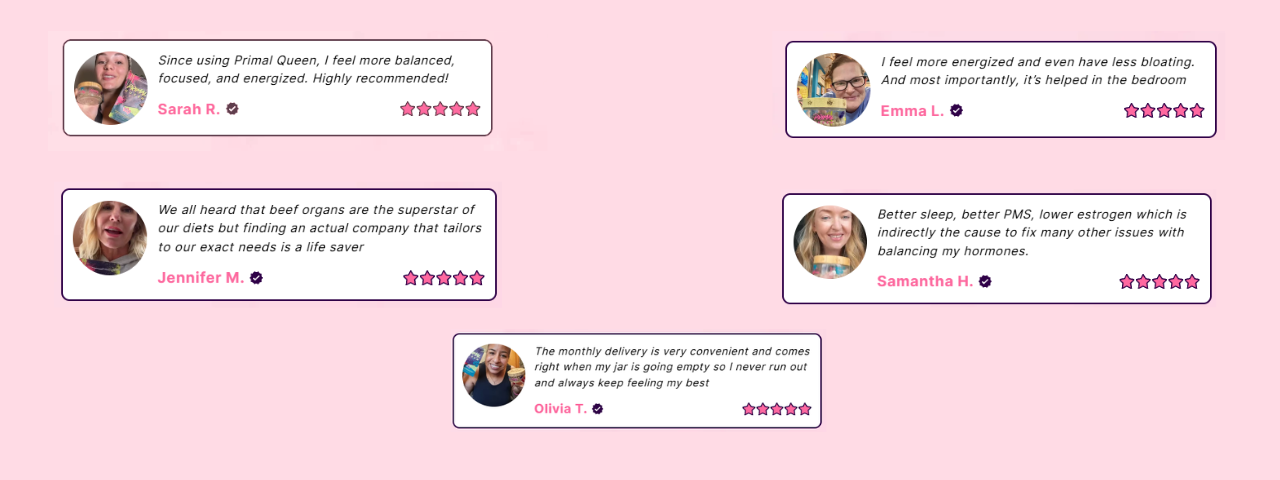
Specificity builds credibility. Named conditions and real timelines, such as "month two," "no cramping this month," "16 lbs down already", signal authenticity in a way that "I feel great!" never could.
They also function as objection-breakers. A skeptical buyer who reads a self-described pessimist raving about her purchase suddenly has permission to believe. If she was convinced, maybe I can be too.
This is what separates brands that use testimonials as decoration from brands that use them as a growth engine.
Types of Testimonials That Actually Work
Before and After Stories
The before/after structure is the most persuasive format among all social proof examples in e-commerce. It mirrors how buyers already think: "what is my life like now, and how could it be different?"
When a customer describes their before state with specificity and then names the change, the reader does the mental math automatically and places themselves in the story.
Use Case Testimonials
These testimonials explain how the customer uses the product in their real routine. Not just that it works, but when, how often, alongside what, and in what context.
This format is particularly powerful for supplements, wellness products, and anything with a learning curve. It reduces friction by making the product feel familiar before the customer has even bought it.
Objection-Breaking Testimonials
The most strategically valuable testimonials address the exact doubt that is keeping a visitor from converting.
For Primal Queen, the biggest objection is obvious: beef organs. A review from someone who actively avoided the product for months before trying it, and then completely changed their mind, speaks directly to every skeptic in the audience.
Identify your top conversion objections, then actively surface testimonials that dismantle them. This is one of the highest-leverage testimonial best practices available to any e-commerce brand.
Where and How to Use Testimonials
Using testimonials strategically across your e-commerce sales funnel ensures that objections are met with proof at every stage.
Product Pages
This is your highest-leverage placement for customer testimonials in e-commerce. A visitor on a product page is already interested, they just need their last objection cleared.
Position testimonials that are specific to that product's primary benefit and prioritize the ones that name real outcomes over generic enthusiasm.
A product with five detailed reviews consistently outperforms one with fifty vague ones. Specificity beats volume at the point of decision.
Landing Pages
When performing landing page optimization, testimonials serve a narrative function that reinforces your core claims. They reinforce the story your copy is telling. Place them near your key claims, not just at the bottom as an afterthought.
If your headline promises hormonal balance, the testimonial right below it should describe exactly that, in a customer's own words.
Alignment between claim and proof is what makes a landing page feel credible rather than promotional. That alignment is what increases trust in e-commerce at scale.
Checkout Stage
This is where cart abandonment happens. Beyond social proof, ensuring a high page load speed at this stage is critical to prevent friction.
A short, specific, outcome-focused review near the final CTA acts as a final reassurance at exactly the moment a buyer is second-guessing themselves.
Do not underestimate how much conversion work a single sentence can do at this stage.
Common Mistakes That Kill Trust
Overly Polished Testimonials
If every testimonial on your site reads like a copywriter wrote it, buyers will sense it even if they cannot articulate why. Over-editing strips the authenticity that makes effective testimonials work.
Lack of Context
A testimonial with no name, no photo, and no situation described is almost worthless. Credibility requires attribution. Name, photo, and a specific situation are the minimum for any customer testimonial in e-commerce to do its job.
No Visual Proof
Text-only testimonials are weaker than they need to be. Where possible, include a photo of the customer, a screenshot of a real message, or a before/after visual.
Unfiltered screenshots from real conversations, with typos and real emotion intact, signal authenticity in a way that a formatted text card simply cannot replicate.
Generic Copy-Paste Reviews
"Good quality, fast delivery" is not a testimonial. It is filler. Collecting better social proof in e-commerce starts with asking better questions.
Instead of "leave us a review," try: "What was going on in your life before you found us? What changed?" Guide the story, and the story will guide your conversions.
Turning Testimonials Into a Growth Asset
Collecting Better Testimonials
The quality of your testimonials is directly proportional to the quality of your questions.
Build a short, structured feedback form that prompts customers to describe their situation before the purchase, what they hoped for, and what they actually experienced.
Send it at peak satisfaction, right after a positive result, not just after delivery. This is the first step in any serious testimonial best practices system.
Structuring Stories
When you receive a great testimonial, check whether it contains three elements: a named problem, a specific outcome, and an authentic voice.
If it has all three, it is ready to deploy. If it is missing one, consider reaching out to the customer for a short follow-up to fill in the gaps.
Reusing Across Channels
A great customer testimonial should not live only on your product page. It can become an Instagram caption, an email subject line, a paid ad headline, a landing page anchor.
The story of the pessimistic cheapskate who could not believe the product worked is a standalone ad concept. The story of the woman who finally had a pain-free month is a brand narrative.
When you start seeing testimonials as content assets rather than review widgets, your entire strategy around social proof in e-commerce shifts, and so do your results.
Conclusion
Testimonials are one of the highest-ROI conversion tools available to any e-commerce brand, and most stores are leaving that ROI on the table by collecting the wrong kind, placing them poorly, or not collecting them at all.
The difference between a customer testimonial that converts and one that gets ignored is not luck.
It is specificity, context, authentic voice, and strategic placement. It is the difference between "great product!" and a woman describing how she finally had a pain-free period for the first time in years.
If a new customer visits your store today and reads your social proof, what do they see? Proof or empty praise?
Start there. Ask better questions. Surface better stories. Build your testimonial best practices into a system. And let your customers do the selling that no ad budget ever could.
Want to strengthen the social proof across your store? Start by auditing what you already have. Most brands are sitting on great stories they have never thought to use.
The brands that win are not the ones with the best product. They are the ones with the best proof. See how vasta.me helps e-commerce brands turn real customer stories into real revenue.