



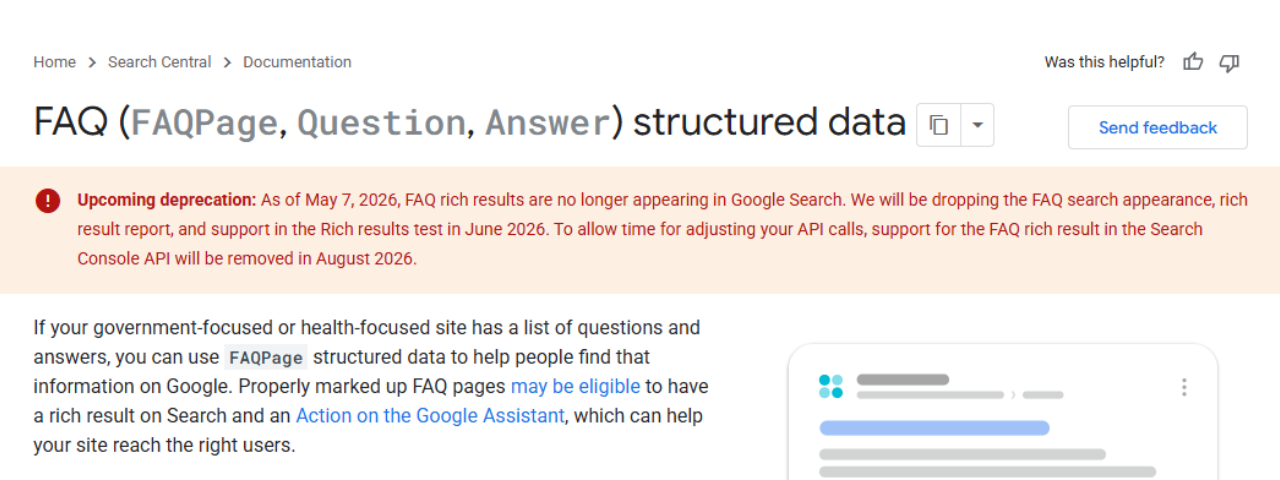
On May 7 2026, Google announced the end of FAQ rich results in Search, which allowed eligible pages to display expandable Q&A content directly in search results. Google confirmed the removal in its official Search Central documentation for FAQPage structured data.
FAQ rich results are no longer appearing in Google Search. Related reporting in Search Console and support in the Rich Results Test will be removed in June, while Search Console API support is scheduled to end in August.
For ecommerce brands, the change is part of a broader movement in search. Google is reducing visual SERP features that were often used to gain extra space, while visibility is becoming more dependent on useful content, semantic clarity, authority, and how well information can be understood by both search engines and AI systems.
What Changed in Google Search
Google removed the visible FAQ expansion that used to appear below some organic listings in Search. These expandable question-and-answer blocks gave eligible pages more space on the results page and often helped them stand out from standard blue-link results.
That display layer is now gone. Pages can still include FAQ content, and FAQPage schema still exists as structured data, but Google will no longer show that content as an FAQ rich result in Search.
For SEO teams, this means past FAQ rich result metrics need to be reviewed carefully. Changes in dashboards may reflect the removal of the feature and its reporting infrastructure, not necessarily a loss in rankings or organic performance.
The key point is that Google removed the search display, not the concept of structured answers. Schema can still help search engines understand page content, but it no longer guarantees this type of visibility in the SERP.
Why This Change Was Already Expected
Google’s May 2026 update did not come out of nowhere. In August 2023, the company had already reduced FAQ rich result visibility and limited eligibility mainly to well-known government and health websites.
For most commercial sites, including ecommerce brands, the feature had already lost much of its practical value.
The reason was tied to how FAQ rich results were being used. What started as a way to make helpful answers more accessible in Search became, for many websites, a tactic to occupy more visual space in the SERP.
Instead of improving the user experience, FAQ blocks were often added to pages mainly because they could make listings look larger.
The 2026 update closes that transition. Google removed the remaining visible feature and is retiring the reporting infrastructure around it. But the change does not make FAQ content irrelevant. It separates useful question-and-answer content from the old practice of using markup as a visibility shortcut.
For ecommerce brands, strong FAQ content should still answer real customer questions, reduce uncertainty, and support decision-making across product pages, delivery information, warranties, returns, and checkout flows.
What This Means Beyond the SERP
FAQ content has not lost its value, what changed is how that value appears in search. Google removed the visible FAQ result from the SERP, but the questions behind that format remain part of the customer journey, especially in ecommerce.
For brands, the right response is not to remove FAQ sections, but to review whether those answers are useful, visible, accurate, and aligned with the page’s purpose.
A strong FAQ still helps users make decisions, while also giving search engines and AI systems clearer context about the content, the product, and the intent behind the page.
This is why structured answers still matter in AI search. AI Overviews, ChatGPT, Gemini, and other answer engines depend on clear information to interpret, summarize, and reference content.
The FAQ rich result may be gone from Google Search, but the need for well-organized answers has become even more important.
FAQ Structure Still Matters in the AI Search Era
.png)
Clear Q&A Helps Interpretation
AI systems work better with information that is direct, specific, and easy to interpret. A clear question followed by a precise answer helps search engines and AI models understand what the page explains and when that answer is relevant.
FAQs Reveal Buyer Intent
In ecommerce, questions often show the concerns behind a purchase, such as fit, compatibility, delivery, warranty, safety, or product use. That makes FAQ content useful beyond SEO, because it helps clarify what the buyer needs to know before making a decision.
GEO Expands Visibility Beyond Rankings
With AI Overviews, ChatGPT, Gemini, social search, marketplace search, and image search, visibility is no longer limited to traditional rankings. Brands need content that can be found, understood, and referenced across different search environments.
What Ecommerce Brands Should Do Now
For ecommerce brands, the priority now is to treat FAQ content as part of the buying experience, not as a shortcut for extra visibility in the SERP. Generic FAQ blocks created only for SEO are less useful, especially when they repeat obvious information or sit far from the moment where the user needs an answer.
The better approach is to keep FAQs where they support decision-making, such as product pages, collection pages, checkout flows, shipping information, warranty pages, return policies, and subscription experiences.
These sections should answer real buyer questions about fit, materials, compatibility, delivery, guarantees, product use, and post-purchase expectations.
This also puts more weight on semantic clarity across the entire site. Product titles, descriptions, internal links, image alt text, category copy, structured data, and technical foundations all need to work together to make the store easier to understand.
For scaling ecommerce brands, this is where SEO connects directly with UX, CRO, and development, turning content structure into a stronger experience for both users and search systems.
How Search Visibility Is Changing
SERP Features Are Becoming More Selective
Google has been reducing inflated SERP features for years, and FAQ rich results became one of the clearest examples of a format that was easy to overuse. What once helped users access quick answers often became a way for websites to take up more space in the results page.
The broader signal is that search visibility is becoming less dependent on visual enhancements and more dependent on the quality, clarity, and usefulness of the content itself.
Search Behavior Is Becoming More Complex
Users are moving from short keyword searches to more specific, conversational questions, often expecting comparisons, explanations, and direct guidance within the same search experience.
For ecommerce brands, this shift is especially important because buyers rarely make decisions from a single search. They compare products, evaluate trust signals, look for proof, check policies, and move across different platforms before purchasing.
Content needs to support that journey with clear answers, not just optimized formatting.
Clarity Now Carries More Weight Than Formatting
Modern SEO still depends on strong technical foundations, including crawlability, speed, structured data, internal linking, and mobile performance. But formatting alone carries less weight when the content does not clearly answer user intent.
For ecommerce brands, this connects SEO with UX and CRO. Visibility brings users to the site, clear content helps them understand the offer, a strong experience helps them continue, and technical performance keeps the journey smooth.
The Direction SEO Is Moving In
Technical SEO still matters, but its role is changing. Structured data, crawlability, internal linking, canonical tags, XML sitemaps, redirects, mobile performance, and page speed remain important because they help search engines access, process, and understand a site.
Google has also reinforced that foundational SEO practices continue to matter for AI Overviews and AI Mode.
The difference is that technical execution can no longer compensate for weak content. The decline of FAQ rich results shows how fragile tactics become when they depend on a specific SERP feature.
A stronger ecommerce SEO strategy builds assets that continue to create value even when search layouts change, including useful product education, clear category architecture, optimized images, trust signals, strong internal linking, and content that answers real buyer questions.
For ecommerce brands aiming to scale, the future of SEO is broader than ranking on a single results page. Brands need to be found across search engines, AI systems, marketplaces, social search, visual search, and conversational interfaces.
That means building a store that is technically sound, easy to understand, credible enough to be referenced, and clear enough for customers to navigate with confidence.
FAQ rich results are gone. AI Mode is here. The brands that adapt fastest are the ones with real content assets behind them. Book a Call and see how Vasta builds ecommerce SEO that holds.