



Search is undergoing the most dramatic shift since Google launched nearly three decades ago. The traditional model built around blue links, text queries, and web pages is being replaced by a multimodal system where answers come from video, images, transcripts, voice and AI-generated synthesis.
Within this transformation, YouTube has quietly become one of the most influential engines shaping what people learn, compare and ultimately decide to buy. It is no longer a platform that complements SEO. It functions as search infrastructure and, increasingly, as training data for the models generating AI Overviews inside Google itself.
This shift affects any brand that still treats video as a secondary effort. Human behavior shows a clear pattern. People learn through video, evaluate through video and trust what they can see.
YouTube now influences visibility not just inside its own ecosystem but across Google Search, Discover, Shorts and AI-driven summaries. The brands that fail to produce structured, intentional video content are not simply missing an opportunity. They are phasing themselves out of the surfaces where modern discovery happens.
If a strategy continues to treat video as a side project, invisibility becomes the default outcome.
The Invisible Shift Redefining How Search Works
For two decades, SEO operated on a stable logic. Optimizing text and webpages, researching keywords, building backlinks and securing a spot in ten blue results formed the playbook. This model worked because search was primarily textual. Each query produced a list of links and SEO success meant appearing above the fold.
That model collapsed once generative AI entered mainstream search behavior. Google, Perplexity, You.com and other engines began delivering synthesized answers rather than index-based lists. The interface changed from navigation to consumption. Users scan the response and only occasionally click through. This altered the incentives behind SEO itself.
The industry now faces a landscape where discovery happens everywhere, not only inside Google’s core SERP. Video, visuals and multimodal signals influence inclusion in AI Overviews, pushing brands toward search everywhere optimization as the new model for visibility, rather than a Google-only ranking mindset.
GEO, or Generative Engine Optimization, emerges as a discipline focused on visibility inside these synthesized responses. The older mindset that frames SEO as a text-only operation no longer matches how search functions. Persisting with methods from 2010 to 2020 leads to diminishing returns because the environment around them has evolved far faster than most strategies have.
Why We Still Think of SEO as Text
SEO inherited a culture built entirely around writing. Blogs became the universal format. Keywords shaped content calendars. Backlinks signaled authority.
This produced a generation of practitioners who learned to think of optimization almost exclusively through a textual lens.
Google reinforced this model for years, rewarding long-form articles and structured markup while offering predictable SERP compositions.
Many companies remain anchored to this paradigm because it once worked remarkably well. Their processes, teams and mental models were built on top of it. As a result, video continues to be treated as a separate language rather than a core search asset, even as search itself shifts toward a modern, multimodal approach to SEO.
The hesitation does not come from data but from familiarity.
Video requires a narrative approach and a visual grammar that organizations have been slow to adopt. The shift toward treating video strategically is still in its early stages for most brands.
What Changed With AI and Multimodality
AI models now interpret text, audio, images and video simultaneously.
This means search results are compiled using a blend of transcript analysis, image recognition, on-screen text extraction and object detection.
When Google generates an AI Overview, it selects a small pool of citations and video is increasingly included because it clarifies concepts better than plain text. This evolution reflects a broader shift toward non-textual signals influencing search visibility, where meaning is derived from far more than written content alone.
Video works as evidence. It demonstrates, reduces ambiguity and resolves questions faster. One of the reasons AI prefers video sources is that they often contain richer signals: tone of voice, step-by-step demonstrations, visible products, contextual environments and authentic user interactions.
These elements give models a more reliable foundation for generating answers.
SEO therefore expands in scope. Visibility now requires being recognized as a source not only for users but for AI that assembles the responses users see first, reshaping how ecommerce brands approach SEO in an AI-driven discovery landscape.
YouTube as a Search and Discovery Engine
YouTube’s role in search becomes clearer when you look at its scale. Traffic rankings from Semrush consistently place YouTube as the second most visited website in the world, behind only Google.
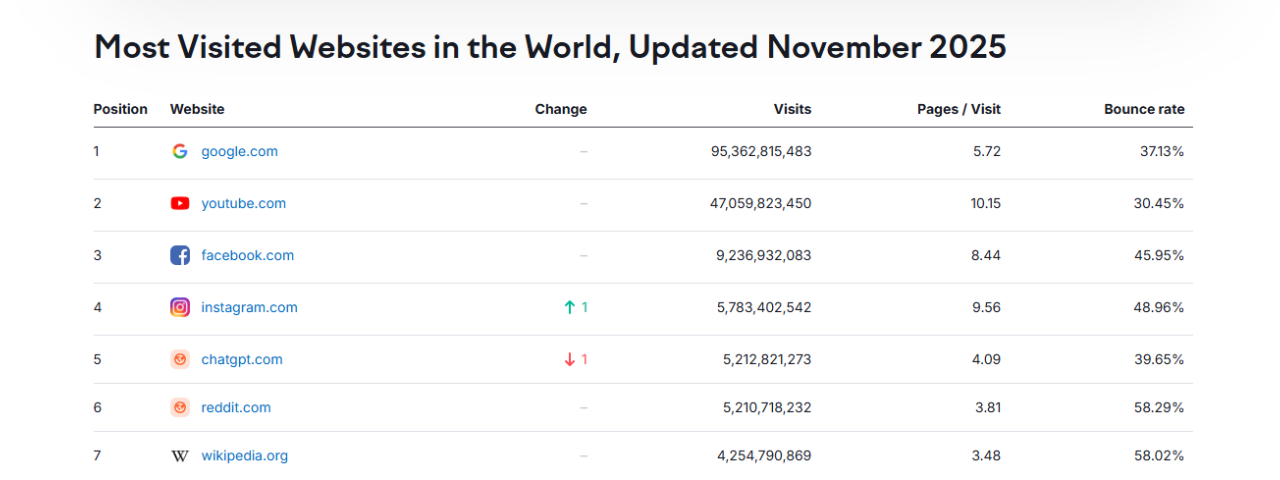
This positioning matters because it shows where users actually begin their information journey. When a platform reaches this level of global visibility, it stops functioning as entertainment alone and becomes essential search infrastructure, signaling where search is heading in the new search era.
Users rely on YouTube to learn, compare and validate. It operates as a visual search engine where queries lead not to static text, but to demonstrations, explanations and real experiences.
This changes how people interpret information. Instead of scanning paragraphs, they observe tone, process, technique and outcome. The format reduces ambiguity and accelerates understanding.
Because of this, YouTube captures deeper forms of intent: how-to tasks, reviews, troubleshooting, comparisons and decision-making moments. These queries reveal uncertainty and often shape the final steps before a purchase. Ignoring YouTube in an SEO strategy means overlooking one of the most influential discovery surfaces in modern search behavior.
Why We Learn Better Through Video
Video reduces cognitive load. It presents information in a linear, guided format, which shortens the time between confusion and comprehension. A demonstration bypasses the need to interpret technical descriptions.
This is why tutorials and reviews have become some of the platform’s dominant categories. Visual walkthroughs solve problems that text alone struggles to address.
Types of Intent YouTube Captures Better Than Google
Certain searches favor video because they require nuance. Practical demonstrations, side-by-side comparisons and troubleshooting benefit from visual context.
These are the moments when a user moves from interest to evaluation, making YouTube central to purchase influence. When SEO strategies ignore these intents, they overlook a critical phase of the funnel.
The Rise of Connected TVs and the New Search Behavior
YouTube’s role expanded further with the rise of connected TVs. It is now the leading streaming platform in the United States by watch time. This positions YouTube not only as a digital platform but as a modern television environment where discovery occurs passively. Users browse, watch and transition into related content without actively searching, creating new pathways for influence.
Second-screen behavior reinforces this pattern. Viewers often search on their phones while watching content on TV, creating an integrated discovery loop. In practice, television itself becomes a search interface.
Connected TV as a New Search Surface
Watching content now functions as a form of search. Signals such as watch time, retention and engagement indicate intent. AI systems interpret these signals to determine which videos demonstrate authority and relevance. The line between viewing and searching becomes increasingly blurred.
Why Google and AI Cite YouTube More Than Ever
Google surfaces YouTube videos throughout SERP, Discover, Shorts and featured results. Research indicates nearly one-third of AI Overview citations come from YouTube. This is significant. It means video is not only influencing human behavior but also the AI layers determining what information appears above traditional results.

Models read videos by transcribing speech, recognizing objects, analyzing text on screen and following chapter structures. These components give AI multiple angles for verifying accuracy and interpreting meaning.
Why Video Is a More Trustworthy Source for AI
Video is harder to manipulate. It contains physical context, real processes and observable sequences. AI can check consistency across frames and detect authenticity cues. This raises the credibility of video as a source and increases its chances of inclusion in multimodal search results.
The New Reality of SEO From Ranking to Inclusion
Modern SEO is shifting away from ranking toward inclusion. AI Overviews reduce the real estate available in traditional SERPs.
Being one of the few cited sources inside a synthesized answer may have more impact than holding a top organic position. Video content has a higher probability of being included because it offers clarity and structured evidence.
In this new model, visibility depends less on matching exact queries and more on understanding real user intent beyond keywords, especially when search systems synthesize answers instead of listing links.
Ranking vs Inclusion
Ranking focuses on position. Inclusion focuses on influence inside the response a user sees first. As citation-based models expand, video becomes essential for maintaining visibility.
What This Means for Brands and E-commerce
YouTube’s influence on e-commerce extends far beyond product discovery.
As the platform becomes a core search engine, it shapes how users interpret credibility, evaluate alternatives and decide which brands deserve attention.
Videos that answer real search intent, troubleshooting, comparisons, performance tests and setup guidance, now function as search assets that help a brand appear across Google surfaces, including AI Overviews and Discover.
For many shoppers, the journey no longer starts on Google alone. They search on YouTube first, or they see YouTube videos pulled into Google results.
This creates a feedback loop where brands with strong video coverage gain more visibility across multiple surfaces, driving branded searches and reinforcing authority signals, highlighting why modern ecommerce SEO requires more than rankings.
E-commerce growth becomes increasingly tied to whether a brand has video content that AI systems can cite, index and understand.
In practice, this means demonstrating product use cases, clarifying edge cases, showing variability in real conditions and answering the questions customers actually type into search bars.
When these assets exist, they improve inclusion in multimodal results. When they don’t, the brand becomes invisible at the exact moment users try to validate a purchase.
How Video Removes Objections and Accelerates Decisions
Objections today often appear as search queries, “does it break?”, “is it worth it?”, “how does it actually look?”, “what happens if…?” YouTube is where users expect these uncertainties to be resolved. A video can show performance across different scenarios, highlight limitations honestly and illustrate the setup or usage steps that written descriptions fail to convey.
AI systems also interpret these videos as signals of reliability and completeness. A detailed walkthrough, a stress test or a side-by-side comparison supplies machine-readable evidence that text alone cannot provide. This increases the chance that the content is included in answer summaries and shortlists.
The result is faster decision-making. When a user sees a product functioning in a realistic context, the cognitive gap between curiosity and confidence closes quickly. Brands that treat these videos as part of their SEO surface, not as social media collateral, reduce friction across the funnel, a core principle of conversion rate optimization across high-intent touchpoints, and help users progress naturally from search to purchase.
Common Mistakes That Harm Video SEO
Several mistakes limit visibility. Treating video as social content instead of search content weakens discoverability. Producing videos without clear intent, publishing with branding-heavy titles and neglecting chapters or transcripts all make it harder for AI and users to interpret relevance.
Separating video strategy from SEO strategy is another limitation because it fractures the search ecosystem rather than integrating it.
How to Start Without Becoming a Massive YouTube Channel
Strategic video does not require large-scale production. A focused cluster based on real queries provides more value than quantity.
Each long-form video should address a clear intent, include chapters and rely on accurate transcription. Shorter versions help accelerate discovery across Shorts while reinforcing the cluster.
Initial Priorities to Start Getting Results
Identify the first cluster of topics. Build titles that reflect actual search behavior. Add transcripts, well-structured chapters and clear thumbnails. Create two Shorts linked to each long-form video to amplify reach and form early intent signals.
Structuring Video Content for Search Visibility
Effective video SEO isn’t about publishing isolated videos. It’s about structuring content so each asset reinforces the others. When videos are grouped around a shared theme, they signal depth, relevance, and authority — both to users and to AI systems interpreting topical coverage.
This is why clusters matter more than volume. A focused series that answers related questions creates a coherent knowledge surface, making it easier for models to understand context and for users to progress from exploration to decision. Over time, this approach compounds visibility instead of fragmenting it, reflecting the logic of building scalable content architecture rather than chasing one-off wins.
Once this structure is in place, titles, chapters, and transcripts stop being tactical details and start functioning as navigational and interpretive layers within a larger system.
Writing and Optimization Guidelines for YouTube SEO 2026
YouTube metadata acts as a map for users and AI. Titles aligned to search queries improve clarity. Chapters guide navigation. Transcripts and captions supply the textual layer models rely on. Consistency across video clusters helps build authority.
How to Write Titles That Work for Humans and AI
Titles should present the core question directly. Clarity outperforms creativity. Branding appears later, not upfront. Staying within a readable length improves scanability across devices.
How to Structure Videos for Algorithmic Understanding
Clear chapter names help both humans and models understand topical coverage. Accurate transcripts ensure the content is machine-readable.
On-screen text reinforces key points. Stating the primary term or task early gives models a strong anchor for classification.
How to Build Authority Through Clusters and Series
Clusters show depth. A playlist around a single topic creates thematic relevance. Interviews, demonstrations and deep dives help expand coverage. Shorts act as distribution units feeding attention back to the cluster.
Conclusion
Video has become foundational to modern SEO. YouTube now functions as a search engine, a discovery engine and a source used by AI systems to construct answers.
The shift from ranking to inclusion requires strategies that combine text, video, and multimodal assets.
The brands that recognize this transformation adjust how they communicate and structure content.
Choosing a cluster, producing intentional videos and optimizing them for machine and human understanding are the steps that ensure visibility in an era where search is no longer limited to text.