



Think about the last time you visited an online store looking for something specific.
You land on a product page, scroll for a moment, hesitate, and then your attention drifts. Not because the product is wrong, but because the path forward isn’t clear. You’re left to browse, compare, second-guess, and decide alone.
That moment plays out millions of times a day in e-commerce, often ending the same way: the tab stays open, the purchase waits, and the customer quietly disappears.
As traffic becomes more expensive and loyalty harder to earn, this silent drop-off has turned into one of the most costly problems in digital commerce. Brands invest heavily to bring shoppers in, yet often leave them unguided at the exact point where clarity matters most. The result isn’t always a hard “no”, it’s hesitation, friction, and lost momentum.
The best-performing stores don’t just shout louder or push harder, they pay closer attention. They anticipate the next step, subtly guide the customer forward, and reduce friction along the way.
This guidance, while almost invisible in execution, is where tailored recommendations in e-commerce begin to show their value, driving higher engagement, fuller baskets, and more conversions. Understanding how this layer works, and its broader e-commerce personalization impact across the journey, is the starting point for turning relevance into revenue.
When Recommendations Stop Being “Extras” and Start Shaping Decisions
In most e-commerce stores, personalized product recommendations are treated as decorative elements, rows of products added almost by default. A carousel here, a “you may also like” section there. They exist, but rarely feel essential.
In high-performing stores, recommendations play a very different role.
They act as a form of guidance, stepping in at moments where customers would otherwise pause, compare endlessly, or abandon the journey altogether. Instead of asking shoppers to figure out what comes next, the experience quietly narrows the field, highlights relevance, and makes progress feel easier.
The difference isn’t subtle. It changes how quickly customers move, how confident they feel, and how often browsing turns into buying.
Personalized vs. generic: relevance as a decision shortcut
Generic recommendations, such as static best sellers or manually curated collections, play an important role, especially for stores in their early stages.
When little behavioral data is available, highlighting popular products or curated assortments can help establish trust, showcase demand, and give first-time visitors a sense of what the brand is known for.
However, as traffic grows and catalogs expand, these same blocks begin to show their limits. Popularity is a useful signal, but it’s a blunt one. It treats every visitor the same, regardless of intent, context, or stage in the journey. Over time, this creates a gap between what the store presents and what individual customers actually need to move forward.
Personalized recommendations build on that foundation by narrowing relevance. Instead of asking shoppers to infer what might work for them, the experience adapts to what they’ve already shown interest in, reducing comparison effort and helping decisions feel more natural. At scale, this shift from general guidance to individual relevance is what turns engagement into consistent conversion.
Where recommendations actually earn their keep
Recommendations appear throughout the shopping journey, but their value changes with context.
Early on, they help visitors explore and orient themselves. Later, they play a more delicate role, supporting confidence, reinforcing intent, and removing last points of doubt.
What helps discovery at the start can become friction if it shows up at the wrong moment.
Seen through that lens, placement stops being a layout decision and becomes a conversion decision. The same logic that works well on a homepage can hurt performance at checkout if it introduces unnecessary choice.
In practice, their role shifts as the journey progresses:
- Early journey:
“Help me find my way.” → discovery and exploration - Mid-funnel:
“Help me choose.” → comparison and reassurance - Late funnel:
“Help me finish.” → confidence and completion
The most common misunderstanding
One of the biggest misconceptions is treating recommendations as a feature you simply “turn on.”
When approached this way, they tend to become noisy, repetitive, or misaligned with user intent, quickly fading into the background of the experience.
Brands that see sustained impact think about recommendations as decision infrastructure.
Each suggestion has a job to do:
- Clarify the next step
- Reduce comparison effort
- Increase confidence at moments of hesitation
Over time, this creates an experience that feels more intuitive than engineered. The logic behind it may be complex, but the outcome is simple: shoppers move forward more easily.
That shift, from decoration to guidance, is what ultimately makes recommendations matter.
How Personalized Recommendations Work
Behind every effective recommendation is a simple question: what would help this customer move forward right now?
The technology that answers it can be complex, but the principle is not. High-performing systems don’t try to predict everything. They listen for the few signals that actually indicate intent, weigh them intelligently, and respond in context.

What separates useful recommendations from noise isn’t the volume of data collected, but the quality of the signals prioritized.
The signals that actually matter
Not all data carries equal weight.
Behavioral signals, what someone is viewing, searching, or adding to their cart, are often the clearest indicators of short-term intent.
Transactional signals add depth by revealing value, frequency, and preferences over time.
Contextual cues such as device or channel rarely drive decisions on their own, but they sharpen relevance when combined with behavior.
Research from McKinsey and Dynamic Yield consistently shows that first-party behavioral data is among the strongest predictors of conversion, precisely because it reflects what a customer is trying to do right now, not who they were in the past.
How decisions are made, not just calculated
Some recommendations follow explicit logic: accessories for a product, refills for a previous purchase, alternatives within a price range. Others emerge from patterns across users and products. In practice, the most reliable systems blend both approaches.
Rules provide guardrails, protecting margins, inventory, and brand intent. Algorithms handle scale and nuance, surfacing relationships humans wouldn’t easily spot. The goal isn’t automation for its own sake, but consistency: showing relevant options without losing control of the experience.
Why timing changes everything
When recommendations update infrequently, they reflect assumptions. When they respond in real time, they reflect intent. That distinction becomes especially important in high-intent moments such as product pages, carts, or search results, where relevance decays quickly.
McKinsey’s personalization research highlights this gap clearly: organizations capable of real-time decisioning capture more value not because they show more recommendations, but because they show the right ones while the decision is still in motion.
Where Recommendations Actually Influence Conversion
Recommendations increase conversion by reducing the effort required to move from interest to action, one of the clearest drivers of conversion rate uplift through personalization. Most purchases don’t fail because intent is missing, but because the experience introduces hesitation at the wrong moment.When recommendations align with intent, e-commerce CRO personalization helps preserve momentum.

Their impact tends to fall into three patterns:
- Cross-sell and upsell
Complementary or higher-value options work when they complete a decision rather than expand it. On PDPs and in carts, well-timed suggestions consistently increase AOV without suppressing conversion.
- Discovery and decision speed
In large catalogs, recommendations narrow the field and reduce comparison fatigue, helping shoppers reach a decision faster instead of stalling.
This dynamic becomes especially clear in large, performance-driven retail environments.
Example:
In brands like ON, personalized recommendations are applied across the shopping journey to accelerate decisions rather than push promotions. By adapting product suggestions based on real-time browsing behavior, context, and device, the experience helps shoppers navigate broad assortments with less friction, reducing comparison fatigue and shortening the path from interest to purchase.
In practice, this approach has delivered reported conversion uplift of around 16%, reinforcing the role of recommendations not as surface-level enhancements, but as core drivers of both UX quality and commercial performance.
- Last-step reinforcement
In carts, recommendations can recover revenue by addressing hesitation, low-risk add-ons, essentials, or reassurance items. Research from Dynamic Yield shows cart-level personalization often delivers some of the highest incremental revenue per impression.
Where they perform best varies by context:
- PDPs and carts: strongest conversion and AOV impact
- Homepages and collections: discovery and engagement
- Checkout: must be used sparingly to avoid distraction
When matched to intent and timing, recommendations stop being suggestions, and start becoming conversion accelerators.
Why High-Performing Recommendations Work
Recommendations work because they support how people actually make decisions online: quickly, imperfectly, and with limited attention. At most moments, shoppers aren’t looking for persuasion, they’re looking for relief from uncertainty.
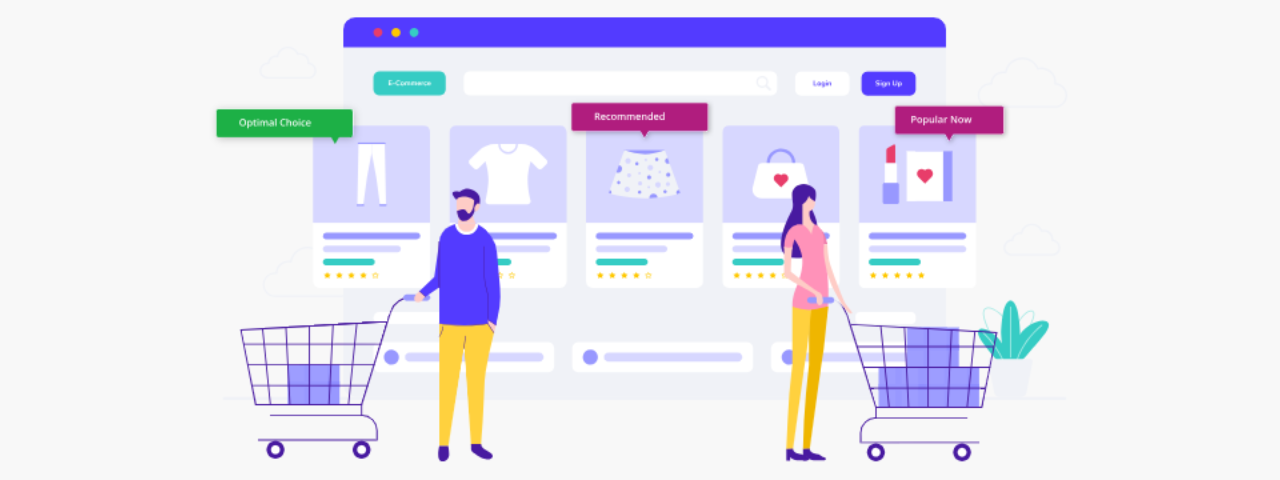
Their psychological impact comes down to a few core effects:
- Reducing friction and mental effort
By narrowing options and surfacing what’s most relevant, recommendations simplify decisions. Fewer comparisons mean less cognitive load, and faster movement toward action.
- Signaling relevance and understanding
When suggestions clearly reflect intent, they create a sense that the store “gets it.” Salesforce research consistently links perceived relevance to higher trust and stronger repeat purchase behavior.
- Maintaining momentum through social cues
Signals like “popular,” “trending,” or “frequently bought together” work because they reduce doubt, not because they create pressure. Used sparingly, they help customers feel comfortable moving forward.
- Shaping choice without overwhelm
Good recommendation design guides attention. Poor design adds noise. The difference often determines whether a shopper progresses or stalls.
As one recurring CRO insight puts it:
“Personalization isn’t about persuasion, it’s about removing the reasons not to buy.”
When recommendations remove hesitation instead of adding stimulation, conversion follows naturally.
The Data: What Impact Recommendations Actually Have
Quantitative benchmarks provide a grounded view of impact, meaningful, but not uniform.
Across industries, personalized recommendations typically drive:
- CTR increases of roughly 5–30%
- Conversion rate uplifts between 3–15%
- Revenue lifts in the 5–25% range, depending on maturity and execution quality
McKinsey’s personalization research places revenue uplift for leading companies between 10–15%, with recommendations cited as a central contributor. Dynamic Yield case studies frequently report revenue-per-session gains exceeding 7–10% when recommendations are deployed across multiple touchpoints.
“Personalization typically lifts revenues by 5 to 15 percent, with increases of up to 25 percent in some cases.”
— McKinsey & Company
Why attribution alone is misleading
Click-based attribution often inflates perceived impact. Incremental measurement, using A/B testing or holdout groups, isolates causal effects and prevents overinvestment in low-quality logic.
Variation in results reflects variation in context. Traffic quality, catalog complexity, UX maturity, and data integrity all shape outcomes. Recommendations amplify what already exists; they do not compensate for foundational weaknesses.
Where UX and CRO Converge
Recommendations live at the intersection of experience design and performance optimization, making them a powerful way to improve UX without sacrificing conversion performance. When designed well, they feel like part of the interface. When designed poorly, they behave like ads. That distinction largely determines whether they help or hurt conversion.

How recommendations improve navigation and discovery
In complex catalogs, recommendations function as adaptive navigation. Instead of forcing users to rely solely on menus or filters, they surface relevant paths forward based on intent, helping shoppers recover from dead ends and continue exploring without friction.
How they influence AOV, conversion rate, and purchase speed
By reducing the effort required to compare options, recommendations shorten the time it takes to decide. At the same time, they increase basket size by introducing complementary items at moments where intent already exists. The combined effect is higher AOV, stronger conversion rates, and faster purchase cycles.
UX anti-patterns that reduce effectiveness
Recommendations lose impact when they become excessive or poorly integrated. Common failure points include:
- Too many modules competing for attention
- Weak visual hierarchy that blurs primary actions
- Slow loading or layout shifts
- Suggestions that ignore context or intent
At that point, recommendations stop guiding decisions and start competing with them.
How to Implement Personalized Recommendations with a Focus on Results
Effective personalization strategies in e-commerce prioritize high-intent moments first, expanding only after impact is clearly measured and understood. The goal is to influence decisions where intent already exists, then expand from there.
Prioritize high-intent use cases
Begin with areas where recommendations can immediately affect revenue:
- Product pages: reinforce choice and add relevance
- Cart: increase basket value without reopening decisions
Discovery-focused placements can follow once performance is proven.
Choose tools for speed and control
- No-code tools enable fast testing
- SaaS engines support scale and behavioral logic
- Custom rules provide business control
Most strong setups blend all three.
Match context and messaging
Align recommendation type with intent and use clear labels that explain why items are shown. Relevance beats complexity.
Set guardrails early
Exclude low-margin or out-of-stock items, prevent repetition, and optimize for profit, not just clicks.
How to Measure and Optimize Recommendation Performance
Recommendations only become a growth lever when teams can distinguish between what looks busy and what actually changes outcomes. That requires measurement designed to answer one question: would this purchase have happened anyway?
Measure outcomes, not just interaction
Click-through rate is a starting point, not a verdict. High CTR can signal curiosity, but it can also hide distraction.
A more useful hierarchy looks like this:
- CTR: are recommendations being noticed?
- Conversion rate: do they help users complete a purchase?
- AOV: do they increase the value of committed intent?
- Incremental revenue: do they create new revenue rather than redistribute it?
Incrementality is the most important metric, and the most commonly overlooked.
Design tests to isolate real lift
Standard A/B tests are helpful, but holdout groups are often essential for recommendations. By intentionally showing no recommendations to a portion of users, teams can measure true lift rather than attribution bias.
Segmenting results adds another layer of insight:
- New vs. returning visitors
- Low-intent vs. high-intent sessions
- First product vs. repeat purchase flows
These splits often reveal where recommendations actually earn their keep.
Optimize for clarity before complexity
Many teams over-invest in algorithm sophistication while under-investing in experience tuning. In practice, the biggest gains often come from simpler levers:
- Placement: closer to the decision point
- Volume: fewer options, higher relevance
- Framing: labels that explain why an item is shown
Optimization works best when recommendations are treated as part of the decision flow—not a separate system to perfect in isolation.
Common Mistakes (and How to Avoid Them)
Most recommendation failures don’t come from bad technology, they come from good intentions applied without context. The same patterns show up repeatedly across underperforming implementations.
Irrelevant or repetitive recommendations
When shoppers see the same products repeated across pages or sessions, recommendations stop signaling relevance and start signaling automation. Repetition erodes trust because it suggests the system isn’t actually responding to behavior.
How to avoid it:
Introduce diversity rules, rotate logic by page type, and reset recommendations when intent changes (for example, after a category switch or cart update).
Overload and choice fatigue
Adding more recommendation blocks or showing too many items at once often feels like increasing opportunity, but it usually increases friction. Too many options slow decisions and dilute attention from primary actions.
How to avoid it:
Limit the number of items shown, prioritize the strongest signal, and ensure recommendations support, not compete with, the main CTA.
Over-personalization and “creepiness”
Personalization crosses a line when it feels intrusive rather than helpful. Hyper-specific suggestions can trigger discomfort, especially when the logic behind them isn’t clear.
How to avoid it:
Favor behavioral relevance over inferred personal traits, and use clear framing (“Popular with this item,” “Based on your cart”) to make relevance feel transparent.
Optimizing clicks instead of profit
High click-through rates can be misleading. Recommendations may attract curiosity without contributing to incremental revenue, or worse, distract from higher-value paths.
How to avoid it:
Anchor optimization to profit per session and incremental lift. A recommendation that gets fewer clicks but increases order value or completion rate is often the better performer.
Avoiding these mistakes doesn’t require more sophistication, it requires tighter alignment between intent, context, and business goals.
Recommendations as a Strategic Capability for E-commerce Teams
Personalized recommendations aren’t a feature to be deployed once, they’re a capability that compounds as teams learn where and how relevance changes behavior. The difference between mediocre and outsized results usually isn’t technology, but maturity.
Recommendation maturity in practice
Most teams start with static best sellers or basic rules. More advanced teams move toward behavioral logic, real-time adaptation, and eventually profit-aware decisioning that balances relevance, margin, and long-term value. Each step increases impact by aligning recommendations more closely with intent and context.
Ownership drives outcomes
Sustained results require shared ownership. High-performing organizations align e-commerce, UX, CRO, data, and engineering around a single objective: improving decision quality across the journey. When recommendations sit in a silo, they stagnate.
A pragmatic path forward
Progress doesn’t require a leap to full automation. Teams that succeed tend to:
- start with high-intent use cases
- measure incremental impact rigorously
- expand deliberately across the customer lifecycle
When treated as decision infrastructure rather than decoration, recommendations become a durable growth advantage.
Conclusion
As acquisition costs rise and consumer attention becomes increasingly scarce, e-commerce performance is shaped less by how many products a store can display and more by how effectively it can guide decisions. Personalized recommendations operate at that inflection point. They do not merely influence what users click, they influence how confidently they move forward.
When recommendations are treated as a system rather than a widget, their impact compounds. They reduce friction across the journey, accelerate product discovery, and quietly reshape purchase behavior in ways that lift conversion rates and order value over time. The most resilient gains emerge when relevance is paired with disciplined measurement, UX coherence, and a clear understanding of where recommendations truly add value.
The competitive advantage, increasingly, lies in precision. Brands that outperform are not those that maximize exposure, but those that understand context, intent, and timing, and translate that understanding into meaningful guidance at every step of the experience.
What's Next?
As e-commerce becomes increasingly competitive, personalized recommendations are no longer optional, they’re a growth imperative. To effectively implement and optimize these systems, explore Vasta’s tailored solutions for SEO, CRO, and development. Stay ahead of the curve by following ou CEO, Igor Silva, on Instagram and YouTube, where he shares actionable insights and strategies from top-performing e-commerce brands.